Ensuring the accuracy of Doppler velocity with NCAR radars is straight forward, and is based upon frequency measurement techniques applied to test pulses placed into the radar receiver. In terms of the relationship between offset frequency and Doppler velocity, the radar is very well calibrated.
The real world introduces the majority of the error in a velocity measurement. Accurate measurement of the velocity of a distributed target is a function of beam dwell time, interpulse correlation of the scatterers, velocity spectrum width (individual scatterers move at different speeds!), possible contributions by antenna side-lobes, and a host of other effects. For a more complete discourse on measurement of Doppler velocity, you'll have to refer to texts and papers in the field.
Other significant error may be introduced in velocity measurements by radar system internal noise imposed upon return signals. The internal noise may be either random (white noise), or it may show a dominant phase. System noise generally affects only weak echo return, but, because the NCAR radars are highly sensitive, every effort is made to reduce such noise. Random noise is generally not a concern, and is eliminated through the digital processing used to recover the dominant velocity phase shift. Tests can be performed to detemine if non-random noise exists.
By definition, non-random noise exists if the spectrum of velocities measured by the radar in areas of noise return is not uniform. In practical application, this means you should have a "flat" velocity distribution if you are passively "listening" for return (receiver not transmitting, and antenna not pointed at potential signal sources), or if you are monitoring the return in regions high above the atmosphere (where nothing but noise return is expected), but with the transmitter operating. In practice, the system is checked both with the transmitter "on" as well as "off"; this allows a user to determine if the transmitter is a source of non-random noise, or if the noise originates elsewhere.
If noise is found to exist, it may be eliminated by removing the cause of the noise (not always possible within the realm of engineering limitations!), or the effects may be mitigated by applying a filter or an adjustment scheme that removes an appropriate amount of noise energy in the appropriate frequency range. This latter process can be exercised on command within the NCAR radars to reduce the particular source of noise found to exist for CP4 in WISP94.
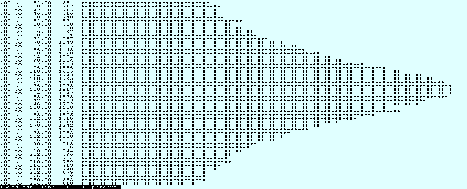
The velocity histograms referenced in this section of the report were produced using the ATD Radar EDITOR software. Number occurrence of a given velocity is plotted against that velocity value; the number occurrence scale is self-adjusting. Velocity units are native to the RSF field data tapes, and are integers that vary in value between zero and 255 radar processor counts (a single, 8-bit byte is used for representation of the full Nyquist range of velocities; the Nyquist must be know in order to convert processor counts to velocity). Note that, in some cases, the full byte range is not actually used for the velocity counts (e.g., the actual integer values of the velocity counts may range from 3 thru 252, only). Velocity processor counts were used in the historgram to avoid creating artifacts due to potentially poor bin selection based upon scaled velocities. The velocity processor count field is referred to with the two-letter abbreviation, BV.
Histograms were created using gate-weighted values of velocity, as opposed to area-weighted values (gate sizes change with the square of radar range, and area-weighting would have produced non-integer values of velocity). In all cases, only data beyond some minimum radar range were incorporated in the historgrams. A legend at the top of each graph gives further details of the plot. Histograms are plotted with a column width of 132 characters. A zero velocity corresponds to a processor count of 128.
Non-random noise was found in the velocity noise spectrum for CP4 immediately prior to the start of WISP94. On 21-Jan-94, an analysis of velocity noise produced a histogram that showed a definite bias toward a zero velocity. Please review the histogram file by clicking here (note: you may wish to clone another window for this review). For this histogram, the CP4 radar transmitter was turned "off". A zero velocity (processor count of 128) shows a number occurrence in noise that is three to four times greater than the occurrence of velocities at the other end of the Nyquist interval.
With the CP4 transmitter turned "on", the situation is only slightly different. The peak near zero velocity (128 processor counts) is not as prominant, suggesting that there is some transmitter noise, but that this noise manifests itself as random in phase, and the source of the zero-velocity bias is due to something other than the transmitter. Click here to review the histogram for CP4 when the transmitter was operating (histograms at two elevation tilts are present in this file).
Based upon engineering experience and the past history of problems with NCAR C-band radars, the source of the non-random noise was traced to a slowly varying voltage offset in the A/D cards of the radar processor.
Mitigation of the zero-velocity bias problem is undertaken through subtraction of an appropriate amount of phase-dependent energy prior to the determination of Doppler velocity. This is done for each gate of data. The amount of energy to be removed is periodically estimated by turning off the radar transmitter and measuring the power of the noise vs the velocity processor count; the noise floor is then determined, and the difference between the noise floor and the phase-dependent energy is saved (stored in memory). This phase-dependent noise contribution is then subtracted during the process of velocity estimation.
In CP4, phase-dependent noise typically changes with time, but not very quickly. The noise removal correction was re-determined every 15 minutes during WISP94, and this proved frequent enough to maintain a reasonably flat distribution in the velocity noise spectrum.
For an example of the stability of the correction process (or the rate of change in the noise), please click here. This file shows a series of histograms produced from a number of sequential scans (scans are at a reasonably high elevation angle in a region of no significant echo). Time span of the scans is approximately four minutes. Note that there is relatively little change in the noise spectrum over this time period. Based upon information similar to this, it was determined that corrective procedures at half-hour intervals would be adequate to preserve data quality; a correction interval of 15 minutes was selected to be conservative.
For an example of what can happen to the velocity noise over long periods of time if no corrections are applied, click here. These histograms are for 15-degree elevation tilts and cover a time period of about 8 hours; histograms are either 10 or 20 minutes apart. Note that the velocity noise generally increases with time, but does self-correct, on occasion.