 S-Pol TRMM-LBA Brazil 1999
Quick-Look Images: Bird Bursts and Sunrise
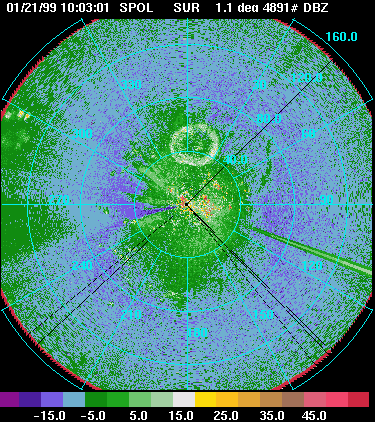
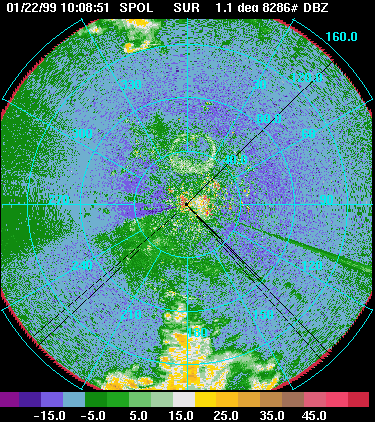
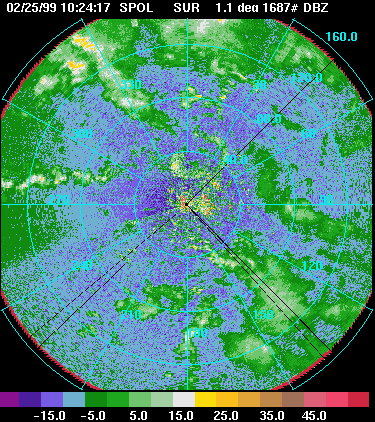
Bird Bursts occur fairly regularly. The burst produces a
ring-shaped echo in the radar display as over-nighting birds leave
their roosting site and radiate outward to begin the days' activity.
This happens at about local sunrise on clear mornings (on cloudy
mornings, the leaving of the roosting area is probably more diffuse).
For S-Pol in TRMM, local sunrise is at about 10:00 UTC; roosting site
is at about 10° azimuth, 40 km range. More than half the project
days show bird bursts. Days with good bursts include:
|
|
When using images on CD-ROM, be
sure to select a date that actually
exists on the currently-loaded CD.
|
Sunrise appears as one or two beams of microwave energy with
above-noise-floor power. The sunrise appears in the scans nearest to
1005 UTC, at an azimuth between 100° to 110° (depending upon
the date).
Sunset also appears, with a time near 22:30 UTC, and an azimuth
between 250° to 270° (depending upon the date). See 21-Jan-99
at 22:29 for a good example of sunset. Note that the recognition of
sunset is complicated by the presence of late afternoon convection,
and terrain blockage toward the west.
Information Updates (on the Web)
--- Credits --- / NCAR Atmospheric Technology Division
Created: 28-Feb-1999
Last modified: Sun Feb 28 13:55:42 MST 1999