Chapter 2 Operations Coordination
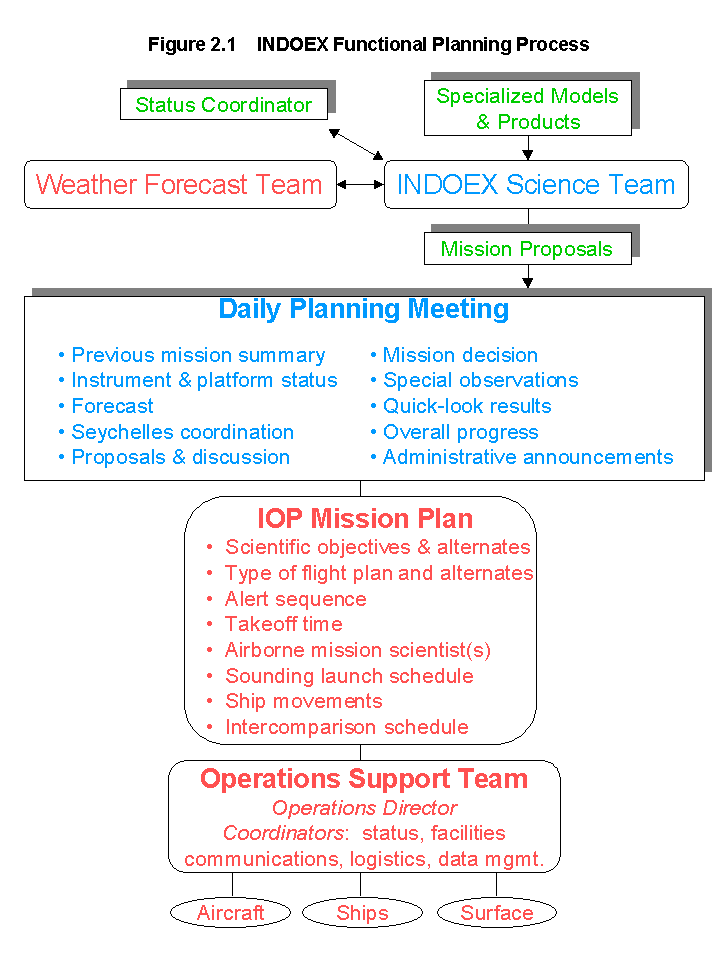
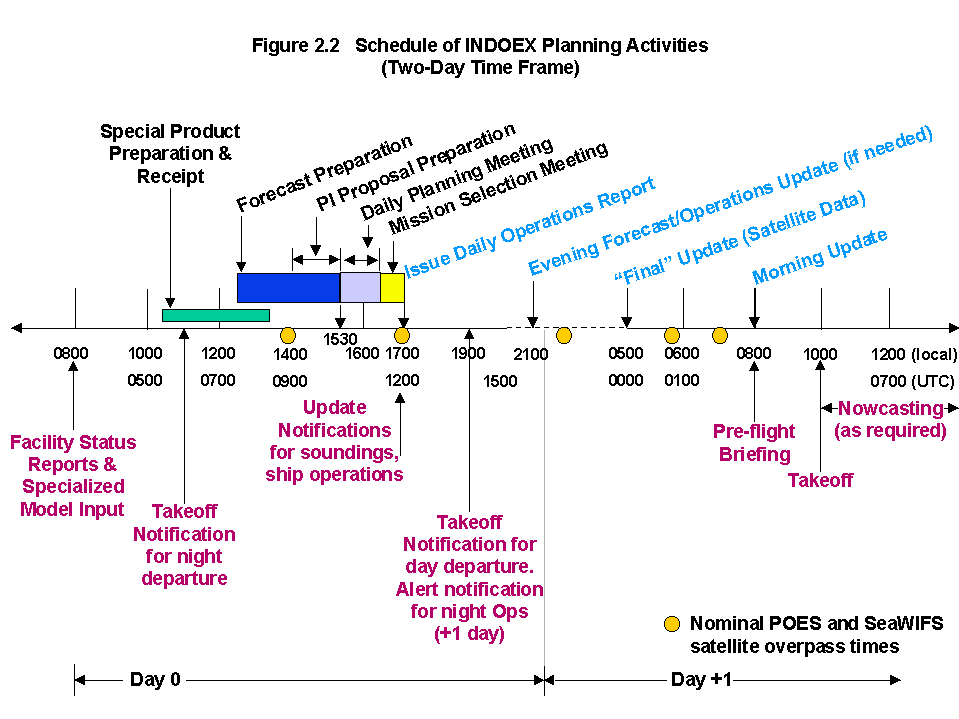
The strategy for preparing daily operational plans and the process for carrying out the observations to meet the INDOEX science objectives will be described in this chapter. It begins with a description of the INDOEX Science Team (IST) (Section 2.2) and the process by which mission plans are proposed and developed; this is followed with a description of the Operations Support Team (OST) (Section 2.3) and the process by which it implements the mission plan. The INDOEX functional planning process is presented schematically in Figure 2.1. The corresponding INDOEX daily planning schedule for a 48-hour period is shown in Figure 2.2. This chapter finishes with a description of the Operations Center facilities.
The IST will consist of all scientists participating in the field phase in Malé. This group is responsible for the day-to-day planning of scientific research activities and data collection that occur during the INDOEX field phase. Principle functions of the IST related to operations support include:
The Chair of the IST will be rotated between the two co-chief scientists (P. Crutzen and Ramanathan), the Project Director (B. Gandrud) and other INDOEX PIs to be chosen from the IST. The Chair is responsible for leading IST activities, especially coordinating preparation of mission proposals, conduct and content of science reviews and will act as liaison with OST on resource management.
2.3 Operations Center Staff and Functions
The OST, headed by the Operations Director, is responsible for carrying out the operational implementation of scientific mission plans formulated by the IST. The INDOEX OST provides six functions critical to the success of the project. They include (1) operations coordination, (2) project status, (3) rawinsonde and ship coordination, (4) aircraft coordination, (5) communications, (6) in-field data management and (7) on-site logistics support. During intensive IOP operations, it may be necessary for several people to perform certain functions continuously for a 24- (or more) hour period. At other times, several functions may be handled by a single individual. Please note that weather forecasting support, while the OST functions, is discussed separately in Chapter 3.
2.3.1 OST Functions and Specific Tasks
Operations Coordination: The primary function of the OST is to ensure smooth operation of support functions during INDOEX that support achievement of the project science objectives. These include the startup, ongoing support and termination of the IOPs.
Project Status Coordination: This function monitors the use of all expendable resources, including aircraft flight hours, sounding expendables and ship schedules. This position is responsible for daily (or as conditions change) updating of the platform and instrument status in the INDOEX on-line field catalog, and alerting the operations director to status changes. A summary status briefing is given at the Daily Planning Meeting.
Soundings and Ship Coordination: This function provides for the notification, updating, and monitoring of all project research ships and special project ground-based sounding locations. This function provides a single point of contact in the Operations Center for sounding locations and ships participating in INDOEX. This function provides for the scheduling and advance notification requirements of all sites, coordinating the receipt of sounding and ship data and status into the Operations Center, and updating such information on the on-line catalog.
Aircraft Coordination: This function provides a single point-of-contact for aircraft facilities to keep updated on schedules and operational plans. This function provides communications support to aircraft during IOPs. It is responsible for including aircraft mission summaries into the on-line field catalog and participating in flight debriefings.
Communications: This function provides a single point-of-contact for all matters related to field communications. This includes the Malé Operations Center local area network (LAN), systems administration, international Internet links, e-mail and telephone connections. This person will coordinate access to locally obtained satellite and weather data needed for operations support.
In-field Data Management: Responsible for the form and content of the INDOEX on-line catalog. This includes coordinating ingest of data and products for operations, forecasting and investigator use. Responsible for ensuring that documentation of all facets of field operations is properly received and input to the on-line catalog.
On-site Logistics: This function supports activities of the OST and other project participants as may be deemed necessary by the Operations Director or IST. This will include clerical, administrative, financial, medical, lodging, travel arrangements and shipping of equipment.
2.3.2 OST Staff Responsibilities
A preliminary list of personnel assigned to OST positions is listed in Table 2.1.
The overall coordination of operational aspects of INDOEX is the responsibility of the Operations Director and staff assigned to the OST.
Operations Director
The Operations Director will serve as a member of the IST and be responsible for directing other OST personnel in carrying out field operations prescribed by the IST. Alterations to IST mission directives as dictated by operational restrictions, safety, equipment failures, etc., are the responsibility of the Operations Director in consultation with the Mission Scientist. This position may require back-up staffing during longer IOPs. Specific tasks include:
Status Coordinator
These tasks are performed daily. Only emergency back-up is required. Specific tasks are as follows:
Sounding-Ships-Aircraft Coordinator
This position will be required on a daily basis and may require back-up assistance during very active periods. Specific tasks are:
Communications and Network Administrator
A single individual will perform these tasks daily:
In-field Data Manager
A single individual will perform these tasks daily:
Logistics Manager
A single individual will perform these tasks daily:
Table 2.1 Proposed OST Personnel
|
Operations Director |
Dirks (Moore, Williams) |
|
Forecasters |
Verver, Stossmeister, Sikka, Maldives Meteorology Department Forecaster |
|
Status Coordinator |
?? |
|
Sounding-Ships-Aircraft Coordinator |
Moore, Williams |
|
Communications and Network Administrator |
Gamage, Bradford |
|
In-field Data Manager |
Williams, Gamage |
|
Logistics Manager |
Martin, Lask |
2.4 Daily and IOP Planning Process
In addition to the enhancement of routine observations during the IFP, INDOEX will conduct a variety of special observations during the field season. The IST will be responsible for defining these Intensive Observation Periods (IOP) that require specific and well-coordinated observations among the facilities in order to achieve the specific INDOEX science objectives. An IOP may vary in length from several hours to several days depending on sampling strategies and specific science objectives to be addressed.
Several steps are required to initiate an IOP that are part of the daily planning process. These include the preparation of PI proposals, determination of science objectives to be addressed, determination of availability of needed facilities and instrumentation, proper weather conditions, determine start/stop times of special high-resolution measurements and available scientific/technical crew for aircraft and other specialized observations.
All Principle Investigators (PIs) interested in conducting IOP data-collection activities will prepare concise proposals for presentation to the IST during the Daily Planning Meeting (DPM). Figure 2.1 stylizes this step in the overall INDOEX mission-planning scenario. The investigators are encouraged to coordinate and combine their proposals to make optimum use of limited INDOEX resources. The proposals should contain the following information:
The PIs will review the latest weather products, special INDOEX products (trajectories, etc) and facility status reports prior to the DPM. Most of these products will be available via the on-line field catalog as soon as they are received in the Operations Center. A short weather briefing will be given several hours in advance of the DPM.
The INDOEX forecast team is responsible for the preparation of forecast information presented each day at the DPM. Complete details of the forecast procedures, available products and content of the weather briefing is provided in Chapter 3. While the PIs are encouraged to work with the forecasters in considering proposals, it is important that the forecasters be allowed to work undisturbed within about 60 minutes of the daily planning meeting. Figure 2.2 shows the timing of the forecast preparations, DPM and subsequent activities.
There will be a general meeting of the INDOEX project each day to discuss scientific plans and accomplishments, facility status and remaining resources, current weather, PI proposals and any other operational or logistics issues of importance. The INDOEX Daily Planning Meeting will be held at 1530 Malé local time (1030 UTC) at the INDOEX Operations Center. The first meeting will be on Monday 8 February 1999 in Malé and the last meeting will occur Friday 26 March 1999. Meetings will be held every day during this period.
The Daily Planning Meeting will be chaired by one of the Co-chief Scientists on a rotating basis, if desired. The Chair is responsible for keeping the meeting on schedule and covering all relevant agenda topics. The Chair will coordinate presentations of mission proposals and work with the Operations Director to finalize the mission selection and mission plan documentation. The Project Director is responsible for keeping track of progress towards accomplishment of project science objectives. The agenda for the daily meeting will include the following items:
A report from this meeting along with the final Mission Plan discussed in the next section will form the basis for the Daily Operations Summary discussed in Section 2.9.
The final step in the planning process shown in Figure 2.1 is the preparation of the detailed Mission Plan. This documentation will be prepared whenever there is anticipation of an IOP beginning within the next 24 hours or an IOP is expected to continue for the next 24 hours. The lead Mission Scientist(s) for the upcoming mission, Operations Director, and others critical to the formulation of mission plans will meet and prepare documentation that will be included in the Daily Operations Summary. The following items will be included:
Members of the IST, Mission Scientists, the Operations Director or Forecasters may request an update at most any time during an active IOP period or in preparation for an IOP start. Morning updates (nominally 0800-0830 Local Time (LT)) will be held regularly to view the latest morning high-resolution polar orbiter satellite imagery in preparation for flight operations that day. Other recent observations and model output will also be available for this update.
It is the responsibility of the Operations Director and the OST to coordinate operations in INDOEX. This includes the day-to-day status reporting, facility interface and updating during routine operations as well as coordination the enhanced observations during the IOPs. Aircraft flight operations after take-off are the responsibility of the Airborne Mission Scientist aboard each aircraft. In the case of changing situations, the Operations Director and lead Mission Scientist and Chief Scientists will attempt satellite or radio communications with the aircraft to alter strategies to best sample the phenomena. If such communication is not possible, it is the responsibility of the Airborne Mission Scientist to continue prudent operations or terminate missions to save flight hours.
The end of an IOP will occur when special high-resolution observations (i.e., aircraft flights or enhanced soundings) in support of IOP science objectives are concluded.
Initial notification of aircraft take-off times will be given by the Operations Director or Aircraft Coordinator to aircraft facilities at least 12 hours in advance and within the aircraft operations procedures described in Chapter 5. A final go/no go decision can be made no less than four hours prior to scheduled take-off. Take-off can be delayed within four hours of scheduled departure within the constraints of aircraft operations procedures described in Chapter 5.
Each flight facility is responsible for filing flight plans with the Maldivian Air Traffic Control (ATC) officials. It may be necessary to provide advance alert to Indian and/or local ATC when flight operations will occur in restricted air space. There may also be requirements for Indian or Maldivian officials to participate in flight operations when flights are planned within the Economic Exclusions Zones (EEZ) of India and the Maldives.
Most INDOEX flight operations will occur during daylight hours. A 24-hour advanced notice will be required if there is a need to shift from daylight to nighttime operations. Individual pre-flight briefings will be held within three hours of take-off for each aircraft. De-briefings, led by the Operations Director, will be scheduled so that all participating aircraft scientists can attend. The timing of this meeting will be determined by the flight schedules, flight duration, etc., but should occur as soon as possible after the aircraft has landed. The debriefing will include:
Several of the flight plans described in Chapter 5 require coordinated aircraft flights with two or more INDOEX aircraft. The location and timing of such operations will be planned in Malé prior to takeoff. The Dutch Citation and French Mystère have about four and three hours of flight duration, respectively, compared with about ten hours for the NCAR C-130. It will be necessary to conduct any multi-aircraft operations in a specific pre-defined period. It will be possible for the Dutch Citation to refuel in Gan when flight missions occur south or southwest of Malé. This will provide a nominal increase in on-station time since the ferry time for the Citation to the area of interest will be reduced. The Operations Director, Aircraft Mission Scientist, aircraft crew and Aircraft Coordinator will work together to plan and carry out these coordinated missions.
2.6.1 Coordination with APE-THESEO Project Flight Operations
The APE-THESEO Project will conduct aircraft operations from the Seychelles, that will overlap for some period of INDOEX flight operations. The Seychelles Operations Center will have telephone/fax services and limited access to the Internet. Plans call for daily telephone/email contact between Malé and the Seychelles to determine if any flight coordination is necessary. In particular the NCAR C-130 will make at least one flight sequence to Mauritius during the six-week field season. During this mission they will try coordinated flight operations with aircraft operating out of the Seychelles. Chapter 5 describes possible coordinated missions and the attendant flight tracks. In-flight communications among the aircraft will be the responsibility of flight crews and the on-board mission scientists.
2.7 Coordination with INDOEX Research Ships
The two INDOEX ships have different communications capabilities. The Ship Coordinator will be responsible for daily contact with the vessels using satellite phone, fax or e-mail. The Operations Center will provide excerpts from the Daily Operations Summary relevant to ship operations, weather in the vicinity, coordination aircraft overflights or other items. The ships will receive this information package following the DPM.
The ships are requested to provide a daily summary of activities to the Ship Coordinator at the Operations Center by 0300 UTC daily. This summary will contain position, instrument status, summary measurements and 24-hour plans. The Ship Coordinator will provide relevant details to the Status Coordinator, on-line catalog and/or DPM, as appropriate.
2.7.1 Ship/Aircraft Coordination
There are two research vessels operating in support of INDOEX. Their schedules and instrumentation details are provided in Chapter 4.
An important component of the INDOEX measurement strategy is the complementary observations using both aircraft and ship-borne platforms. There will be several occasions when the INDOEX aircraft will fly specific flight plans to permit inter-comparison and complementary data collection with the OR/V Sagar Kanya and the R/V Ronald Brown. The Ship Coordinator will be responsible for keeping the ships informed of possible coordinated operations. This will be accomplished on a daily basis via the Daily Operations Summary (see Section 2.7) and more frequently as needed using satellite phone/fax. Once the aircraft are in the vicinity of the ship, contact will be made via VHF-FM radio. Frequencies and procedures are described in the Chapter 8 (Communications) and Chapter 6 (Ship Operations).
2.8 Surface Station and Soundings Coordination
The ability to make complementary observations from surface stations and from project ships or aircraft is crucial to achieving the scientific objectives of INDOEX. It is also important to make detailed measurements from specific surface instrumentation during satellite overpasses to address algorithm retrieval and baseline issues. The Malé Operations Center will serve as a focal point of information for these activities during the IFP. The Sounding Coordinator at the Operations Center will be responsible for providing detailed requests for special observations from the surface and sounding stations. These requests will be communicated via phone, fax, WWW or e-mail following the DPM as part of the Daily Operations Summary (Section 2.9). Details of the surface station deployment and sounding operations are presented in Chapter 6.0.
2.8.1 Kaashidhoo Climate Observatory
The Kaashidhoo Climate Observatory (KCO) will have a wide ranging suite of measurements to support INDOEX. During the IFP, there will be some special scheduling requirements to meet project science objectives. These include the launch of soundings during polar orbiter satellite overpass times and high-resolution aerosol and chemistry measurements bracketing the time of aircraft overflights. The times for satellite overpasses are provided in Appendix C.
Adjustments to the overpass times are likely and will be provided directly to KCO by the Sounding Coordinator. Arrival and loiter times of C-130 aircraft intercomparisons will be provided as part of the Mission Plan documentation. The times of these fly-bys will be updated by direct contact with the Aircraft Coordinator or Airborne Mission Scientist via satellite telephone.
There are several instrumentation systems in the vicinity of the Operations Center on Hululé details of these ground-based systems are discussed in Section 6.6. Coordination of lidar operations and aircraft intercomparisons will be arranged by the Aircraft Coordinator.
2.8.3 Other National Observatories
It may be possible to coordinate some measurements from the Indian coastal observatories with project facilities operating off shore and downwind of specific locations. The timing and nature of complementary measurements will be communicated with all Indian land platforms via phone, fax or e-mail via the INDOEX Indian Operations Center in Bangalore.
Contact point for operations information to and from La Réunion will be:
Dr. Anne Rechou tel: 262.93.86.66
Universite de La Réunion fax: 262.93.86.10
Faculte des Sciences et de Technologie e-mail: arechou@univ-reunion.fr
Laboratoire de Physique de l’Atmosphere
15 Av. Rene Cassin, BP 7151
97715 Saint-Denis Messag. Cedex 9
La Réunion, FRANCE
We can also expect a summary from La Reunion as well. Dr. Rechou will return to La Réunion on 5 Feb. We will make plans for R/V Ron Brown and C-130 coordination with La Réunion.
A Daily Operations Summary will be prepared using information from status reports, the Daily Planning Meeting and the IOP Mission Plan. The report will be prepared by the OST and distributed to all participants via the INDOEX on-line field catalog. Every effort will be made to have the report prepared and distributed within 90 minutes of the conclusion of the Daily Planning Meeting. The report will be accessible via the field catalog within the INDOEX domain in Malé and via the "mirror" catalog running at JOSS in Boulder, Colorado. Special (possibly shorter) versions of the summary will be provided to the ships, if possible, and to the Seychelles Operations Center. These can be faxed or accessible via the Internet. The report will include:
2.10 Other Briefings/Debriefings
In addition to the Daily Planning meeting and other operations related briefings, regular assessments of project activities are needed. A Weekly Project Review should occur to permit an ongoing assessment of the completeness and timeliness of operations support and the degree to which science objectives have been met. This review will include discussion among operations support, facility and science staff to evaluate and adjust, if necessary, any component of operations support. An ongoing assessment of the accomplishment of INDOEX science objectives will be a major component of the weekly review. This discussion can result in modification of emphasis on certain science objectives, adjustments to flight tracks and /or revised intercomparison measurement strategies to better answer remaining questions.
Special Science Meetings will be organized as necessary to evaluate the achievement of specific science goals using available preliminary data and participant in-field analyses. Of specific interest here might be a major redirection of the use of expendable resources (soundings, flight hours, etc.) to document phenomena of interest. These meetings should include all scientific participants and focus on science issues. Operations support personnel will attend to address the operational implications of options being considered. A special all-day Science Review is proposed around the middle of the aircraft program (early March).
Special Seminars will be scheduled as necessary to share preliminary analyses results. These sessions will be scheduled on an ad-hoc basis among interested PIs who wish to share data. One outcome of these seminars may be to convene a broader science meeting.
2.11 Operations Center Facilities
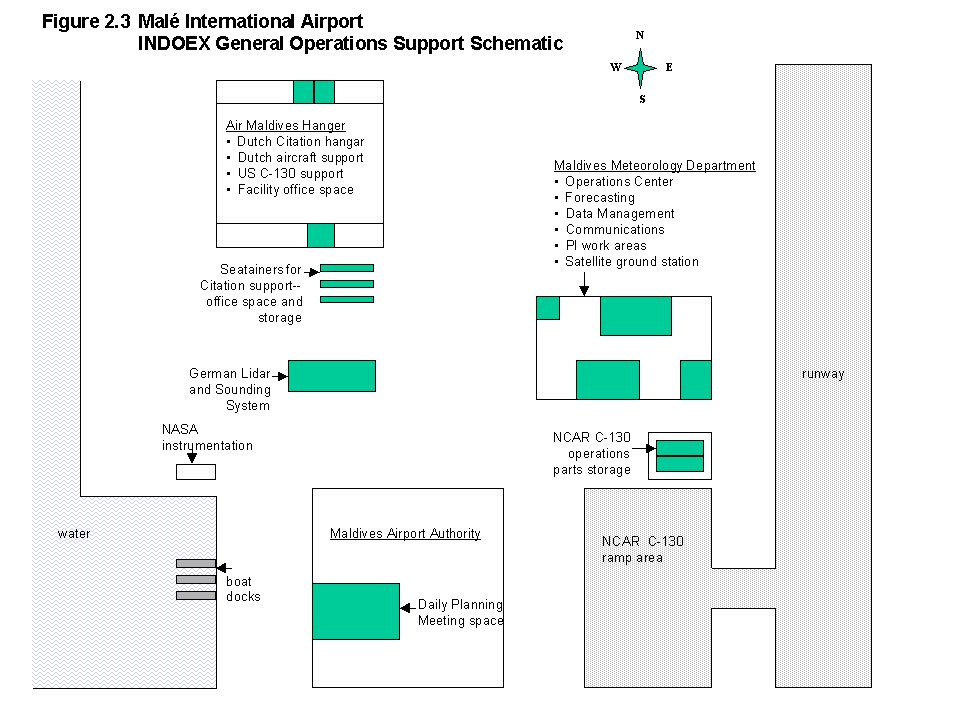
The main operations center for INDOEX will be located at Malé International Airport located on Hululé Island in the Maldives. The Malé Operations Center will be functional by about 4 February 1999 after an initial set-up beginning in December 1998. Equipment, communications capabilities and personnel in direct support of the INDOEX IFP will remain through about March 27, 1999. All this equipment will be removed from the Malé Operations Center by early April 1999. Figure 2.3 provides a schematic layout of space for major INDOEX support activities at the Malé International Airport.
Two major observing systems will remain on Hululé Island after this period. The German lidar will continue to make observations for about one year. The JOSS satellite ground station may continue data collection through the fall of 1999 in support of another field experiment being conducted in the Bay of Bengal.
2.11.1 Offices and Room Locations
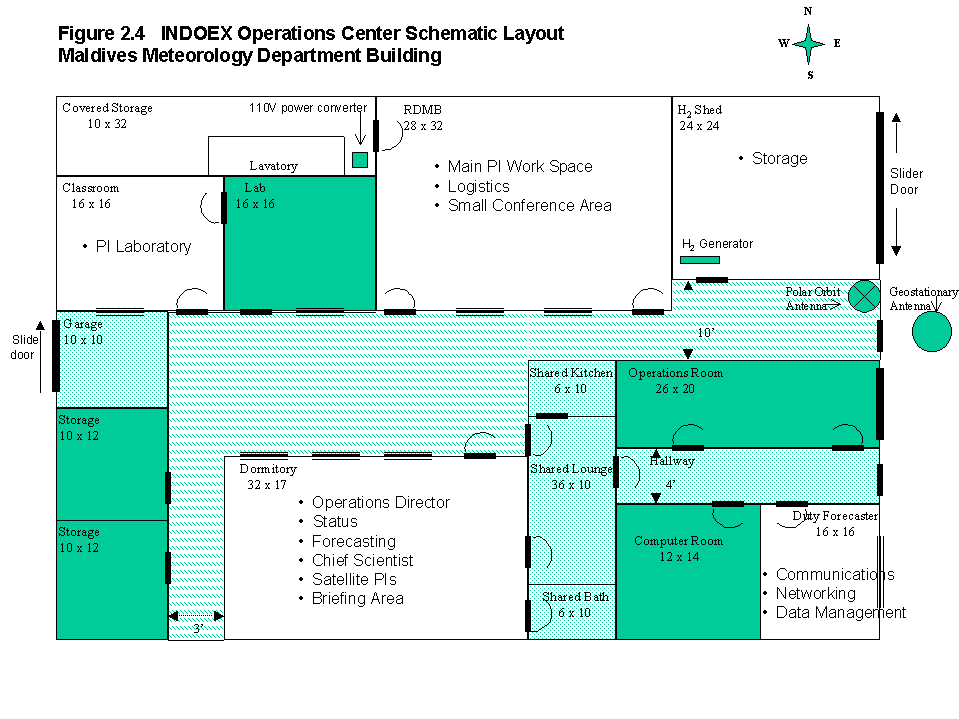
Arrangements have been made with Maldives Meteorology Department (MMD), Maldives Airports Authority (MAA) and Air Maldives (AM) to provide space and other support during the IFP. Figure 2.4 shows where INDOEX Operations Center space is located in the respective buildings of the MMD compound. All of the space will be available by 1 February 1999. A few specific locations in the Meteorology Department will be available during the set-up phase. Offices in the Meteorology Department and Air Maldives Hangar share common restroom and kitchen facilities with existing staff. The meeting room for the Daily Planning Meeting is located in the MAA main building. It will be available for INDOEX use after 1500 LT daily (it is used as a training facility at other times). Temporary office and storage seatainers will be located near the AM Hangar and in a hangar adjacent to the ramp space occupied by the NCAR C-130.
2.11.2 Electricity and Lighting
Electrical power in the Maldives is normally 240V/50Hz. This power source is very unreliable and uninterruptable power supplies (UPS) are highly recommended for all devices. The available office space in the MMD and AM Hangar will have adequate lighting and suitable power for computers and other support devices (fax, copy machines, etc.). The electrical plug used is a "English/Irish style" 3-pronged connector. Participants are responsible for bringing suitable power and extension cords, as well as power strips to meet their own needs.
A limited amount of U.S. power (110V/60Hz) will be provided via converter, if needed in the MMD building ONLY. UCAR/JOSS will provide the converter, connection to the Maldives power grid and power cable to rooms within the MMD. Participants are responsible for power cords.
2.11.3 Telephone Lines, Fax and Computer Network
Telephone and fax services are available in the MMD and AM Hangar buildings. Telephones will be installed by UCAR/JOSS to support direct operations related functions in the MMD. The installation of phones in the AM hangar and for other specific participant needs is the responsibility of the group residing in those locations. UCAR/JOSS will provide phone and fax service in the MMD building for operation support purposes only. Other fax requirements are left to the participants. The Maldives telephone system is modern, yet nearly fully loaded. It will support cell phones, computer and fax modem, pagers, etc. Most U.S. analog cell phones will work after reprogramming at the local telephone company office. Please make sure that the cell phones are compatible with the Maldives system (AMPS). Other communications details may be found in Chapter 8 of this document and in the INDOEX information bulletins.
In some cases air conditioning will be added or augmented as a project expense. Furniture will be provided for INDOEX space and will be augmented at project expense. Participants will be provided bottled water for all personal drinking and coffee/tea needs. Janitorial services will be arranged by the INDOEX Project.
Malé International Airport has a high level of security. Access to INDOEX facilities will require a security pass that must be displayed at all times. Details on how to obtain airport security passes are provided in the INDOEX information bulletins at
http://www.eol.ucar.edu/projects/indoex/
INDOEX personnel will have 24-hour access to the MMD and AM facilities. The MAA meeting room for the Daily Planning Meeting is only available after 1500 LT daily. (The room is the MAA training center and is usually otherwise occupied earlier each day.) INDOEX personnel are the guests of the MMD, AM and MAA. As such it is very important that we abide by any specific facility security rules and respect the property at those locations. All participants will be informed of these procedures when they arrive for the IFP.